
Know what a plumbing check can and cannot tell you before you sign
Buying an older home in the far south? Here's what a plumbing check actually sees. And what it can't reach. This matters before your offer goes unconditional.

By Zaid Petersen, Owner and master plumber
A plumbing check covers what a plumber can see and test on the day: taps, toilets, the geyser, visible pipework, the water meter and the outside drains.
- It depends on reaching the fault: a buried sewer line, a pipe inside a closed wall or a geyser in a sealed roof often can't be seen without extra equipment like a camera.
- It depends on the type of problem: damp walls and structural cracks are usually not plumbing issues at all and need a different specialist.
- The fix is a written report that names both what was found and what couldn't be reached, so nothing is assumed.
What a plumbing check looks at, step by step
- Open and run every tap, hot and cold, in the kitchen, bathrooms and laundry, to watch the pressure and the drain.
- Flush each toilet and check it refills cleanly without running on.
- Look at the geyser. its age, the drip tray, the overflow pipe and whether the water runs rusty.
- Check visible pipes under sinks and in the roof for galvanised runs, green stains or damp.
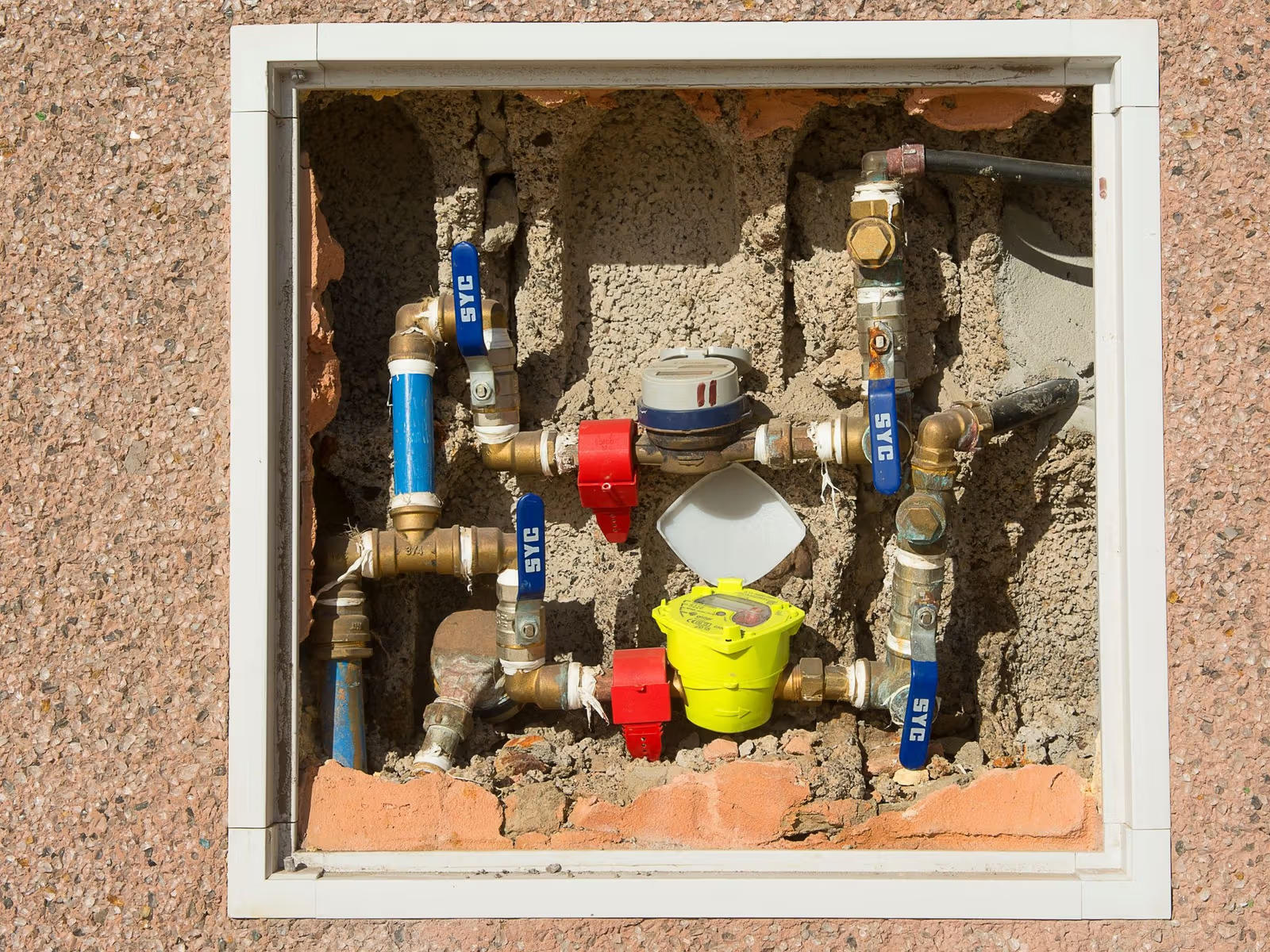
- Read the water meter with every tap closed, then watch it for a few minutes.
- Walk the drains and gullies outside, pour water through and look for a slow run or a backup.
- Write down each defect found, with a photo and note what could not be reached.
Whose problem it is: private property or the municipal network
So a plumbing check has limits. A fault is yours to fix once the pipe sits on your side of the boundary. The dividing line is the municipal connection, the point where your drain meets the City's sewer in the street. Everything from your house down to that point is private property. That is the stretch a plumbing check walks.
Walking that stretch is one thing. Seeing inside a buried clay sewer line is another. In some older homes in Lakeside or Muizenberg, the original clay pipe can still crack or sag underground. Roots push in through the joints. A tap-and-flush check won't show you that. The fault sits out of sight, below the garden.
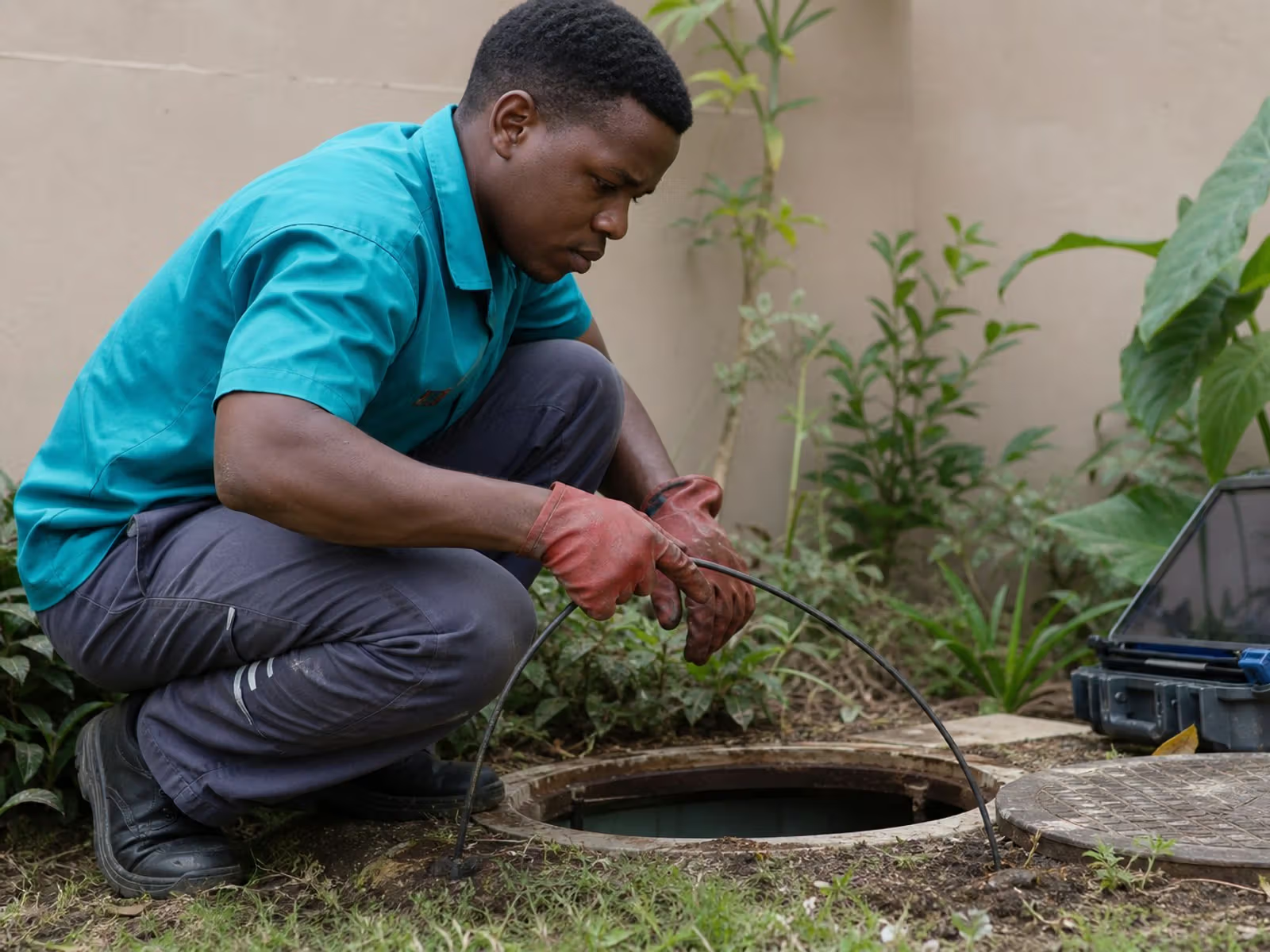
Out of sight is where a camera earns its place. A Drain Camera Check feeds a camera from the nearest access point down to the municipal connection. It records the whole run. You see roots, a crack or a sag instead of guessing. The video lets you see whether the problem sits on your property or past the boundary.
When a plumbing check is the wrong answer
Not every worry is a plumbing worry. A plumbing check is the wrong answer when the thing bothering you isn't plumbing at all. Take a damp wall. It often has nothing to do with a pipe. It can be rising damp from the ground. Or rain getting in through a bad gutter. Either way, that's a question for a damp specialist, not a plumber.
Structural cracks are another case. A sagging floor or a cracked foundation needs a structural engineer, not a tap test. A plumber can tell you a pipe is leaking under the slab. Whether the slab itself is sound is a different trade entirely.
Then there's the hidden leak that a buyer's walk-through will never catch. The meter keeps ticking with every tap off. Somewhere, water is running behind a wall or under the floor. A general check just flags that the meter moves. A Leak Hunt is the visit built to pin down where. It covers a meter test, hot and cold isolation, acoustic listening and a thermal camera scan, with a written report and photos sent to your WhatsApp. One thing worth knowing: finding the leak and fixing it are two separate things. You can ask us for a written quote before any repair work starts. For wider background, see Summary Guide to the City of Cape Town's Water By-law.
What to ask for before you commit
Ask for a written report that lists what was seen and, just as plainly, what could not be reached. That second half is the part that protects you. A buried line nobody could get a camera to, a wall cavity left closed, a geyser in a sealed roof: each of those is a known unknown. You want it named on paper before your offer goes unconditional.
Check that any findings are quoted to you clearly. A good report tells you the defect. A separate quote tells you what fixing it costs. When those two sit in one blurred figure, you can't take the facts to your conveyancer and weigh them against the asking price. Keep them apart.
One more thing to check: who is reading the footage. A registered plumber who has spent years on these old far-south pipes knows what a sag looks like against a shadow. Klipspringer runs the camera as a PIRB registered licensed plumber, registration number PIRB-L-40917. A tenant, a landlord or an agent sorting this out on someone else's behalf can hand that written report straight on. The facts speak for themselves without anyone standing in the kitchen.
Frequently asked questions

Is a plumbing certificate required in South Africa?
a water-installation Certificate of Compliance, issued by a City-registered plumber, must be submitted before the property can be transferred to a new owner, not for a pre-purchase check itself. The CoC tells you the plumbing met the rules at a point in time, but it won't show you a cracked clay pipe under the garden or a geyser near the end of its life. That's a separate check, done on request, before you sign anything.
How much does a home inspection typically cost in South Africa?
The price moves on a few things: how many taps, toilets and outside drains need checking, whether the geyser and roof pipes are easy to reach and whether a camera needs to go down the sewer line to the municipal connection. The only way to get a number that means anything is to ask for a quote against your specific house, not a figure pulled from somewhere else.
How long is a plumbing CoC valid for?
A CoC doesn't expire on its own, but it stops being useful the moment new work changes the system it covered. Add a geyser, move a pipe or extend the bathroom and the old certificate no longer reflects what's actually in the walls. For an older far-south house changing hands, treat the CoC as a snapshot from the past, not proof of today's condition.
Will I be overcharged for something simple, like a tap or small repair?
The way to protect yourself is to ask for the written report and the quote to arrive as two separate things. The report tells you what's wrong. The quote tells you what it costs to fix. If someone hands you one blended number for a simple tap job, you've got nothing to check it against, so ask them to split it before you agree to anything.
Will I be hit with an inflated invoice for work that doesn't even solve the problem?
Ask for photos and a written note on what was actually found, not just an invoice at the end. A fault that's properly diagnosed, with the defect shown and dated, gives you something to compare against the bill. If an invoice shows up with no record of what was seen or done, you've got no way to tell if the work matched the problem.
Will they actually turn up when they say they will, or will I be left waiting and chasing them?
You can't know that from a check-list, but you can ask for a time window in writing before the visit and whether they'll message you if anything changes. A plumber who's upfront about the time, before you even confirm, is a good sign you won't spend the morning staring out the window.
Ready when you are
For more on this, see Finding a water leak. If you would like to take this further, Drain Camera Check is the place to start.
About the author
Related articles
-
How to tell if your house has a hidden water leak
A few minutes with the meter tells you if water is running when it should not be.
Read the guide -
Who pays when a leak pushes up your water bill
See whether a leak on your side of the meter is pushing up your bill and who pays.
Read the guide